Welcome to Asterisk Online Shopping Store !
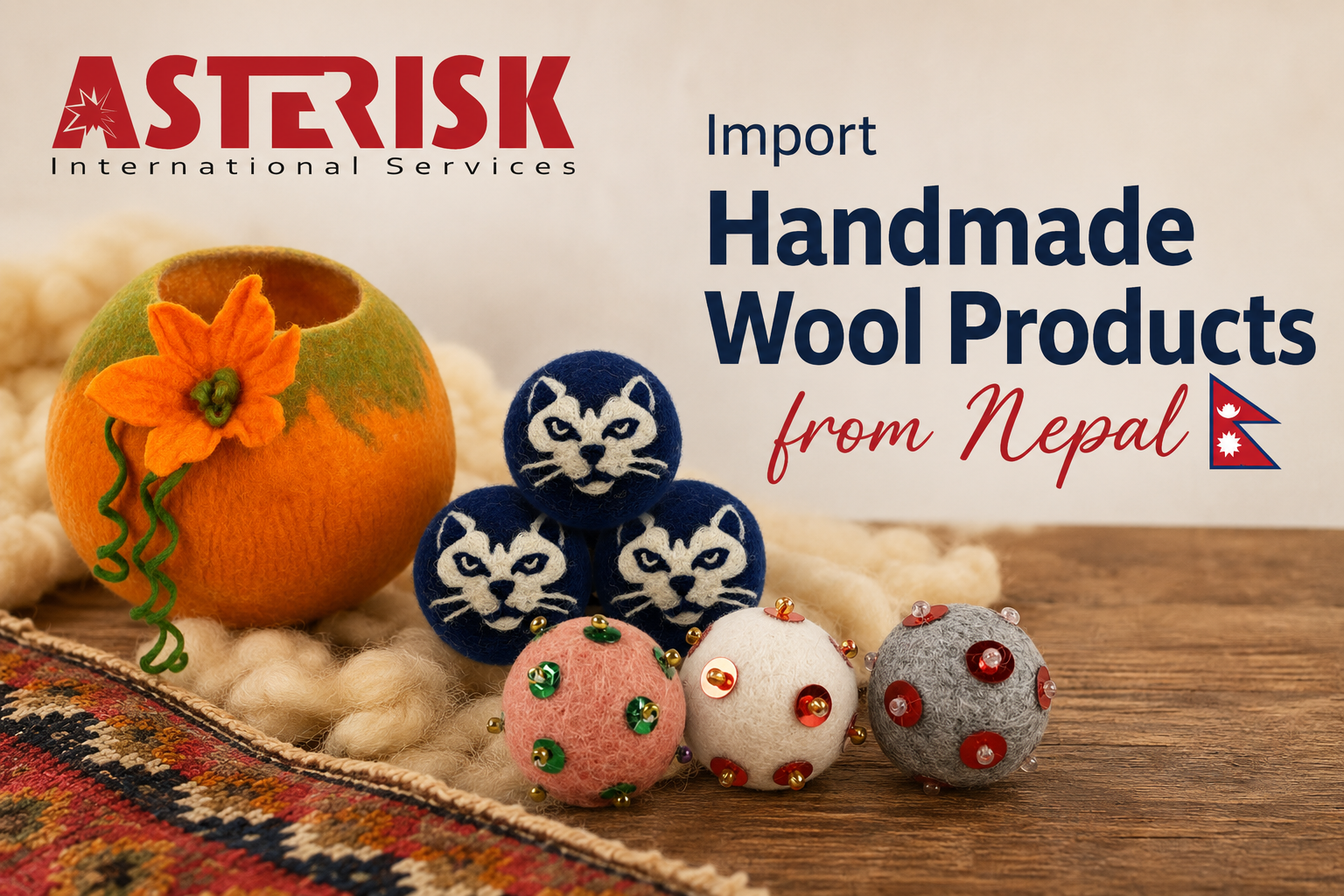
Quick answer: Importing handmade wool products from a Nepal manufacturer gives wholesalers and private label brands access to genuine hand-felted craftsmanship, low-volume flexibility, ethical labor practices, and a wholesale cost structure that undercuts European and North American felt producers by a wide margin provided buyers vet suppliers for certifications, lead times, and raw wool sourcing before placing a first order.
This guide is written for importers, wholesalers, bulk retailers, and private label brands evaluating Nepal as a sourcing destination for handmade wool goods wool dryer balls, felt cat caves, felt balls, wool toys, and related home and pet products. It goes beyond the general "why source from Nepal" overview page one of Google right now, most of which repeats the same three talking points (cheap labor, handmade quality, fair trade) without addressing the operational questions that actually determine whether a first order succeeds: certification verification, minimum order quantities, customs classification, and how to tell a genuine felt manufacturer from a trading middleman reselling the same catalog under a different name.
Nepal's handicraft export sector is going through a visible split. Traditional woolen carpets long the country's signature textile export have been losing ground, with carpet export earnings falling sharply in the past year as global demand shifts toward synthetic alternatives and interior design trends move away from ornate hand-knotted pieces. Felt handicrafts, by contrast, have moved in the opposite direction. Industry association data shows felt products becoming one of Nepal's fastest-growing handicraft export categories, with felt goods alone accounting for a substantial share of the country's total handicraft export value in recent fiscal years.
That divergence matters for buyers. It means the "Nepal wool" category is no longer one uniform story it's a shrinking legacy carpet trade sitting next to a growing felt and small-goods trade that's better suited to modern e-commerce, private label, and wholesale pet/home product lines. Sourcing managers who still associate Nepal purely with carpets are missing where the real capacity and innovation is concentrated today: dryer balls, cat caves, decorative felt balls, and needle-felted accessories built for Amazon, Etsy wholesale, and boutique retail channels.
A second shift worth tracking: Nepal's felt producers increasingly import raw sheep wool from New Zealand and Australia rather than relying solely on domestic Chyangra or hill-sheep fiber, because local wool supply has not kept pace with export demand. This has quality upside (more consistent fiber grade) but also means landed cost is sensitive to global wool commodity prices and international freight a variable importers should ask suppliers about directly rather than assuming pricing is purely labor-driven.
People researching "handmade wool products manufacturer Nepal" are rarely asking a yes/no question about Nepal as a country. They are trying to answer three practical questions at once:
Hidden underneath those questions is often a fourth: private label buyers want to know whether a Nepal manufacturer can produce their design not just sell from an existing catalog. That distinction (contract manufacturing vs. catalog wholesale) is the single biggest gap in most existing content on this topic, and it's the one this guide addresses head-on.
Most published articles on this topic fall into one of two categories: generic "benefits of importing from Nepal" listicles written for a general audience, or single-supplier marketing pages disguised as educational content. Reviewing the current top-ranking pages on this topic reveals consistent gaps:
This guide addresses each gap directly, with a supplier evaluation framework, current sector data, and specific guidance for the product categories where Nepal has genuine manufacturing depth: wool dryer balls, felt cat caves, and felt balls.
Needle-felting and wet-felting are labor-intensive techniques that are difficult and expensive to replicate at scale in higher-labor-cost markets. Nepal has decades of accumulated artisan skill in this specific craft, originally built around the carpet and pashmina trade and now redirected toward felt goods. A single dryer ball or cat cave passes through multiple hand-forming, felting, and shaping stages before finishing work that would carry a significantly higher labor cost if produced in the US, UK, or Western Europe.
Key Takeaway: Hand-felting is a skilled, multi-stage craft. Nepal's decades of textile-artisan experience originally built on carpets and pashmina now supports a growing felt goods sector, giving buyers access to genuine handmade quality at wholesale price points that machine-made or higher-labor-cost alternatives cannot match.
Labor cost is the obvious driver, but the real advantage for importers is the combination of low per-unit labor cost with an established quality-control culture inherited from the export carpet and pashmina trade sectors that have shipped to demanding European and US retail buyers for decades. That combination is harder to find in newer, lower-cost manufacturing regions that lack Nepal's export track record.
Compared to large-scale textile factories in bigger manufacturing economies, many Nepal-based felt workshops can accommodate smaller initial orders useful for private label brands testing a new SKU or a retailer piloting a product line before committing to a full container order. This flexibility narrows as product complexity increases, which is why MOQ should always be confirmed per-SKU, not assumed from a supplier's general marketing claims.
A meaningful share of Nepal's felt manufacturing workforce consists of women in rural and semi-urban communities, and several established manufacturers operate explicitly as social enterprises supporting underprivileged or disabled workers. For brands building a sustainability or ethical-sourcing narrative for their own customers, this is a genuine and verifiable differentiator provided the specific supplier can document it (see the certification checklist below) rather than simply asserting it.
Wool dryer balls, felt cat caves, and felt balls sit at the intersection of three growing retail categories: natural/eco-friendly home goods, pet accessories, and handmade/artisanal decor. Nepal's felt sector has organically specialized in exactly these product types, which means suppliers already understand the design conventions, sizing standards, and finishing expectations that Western retail buyers expect rather than needing to be trained from scratch, as is often the case with manufacturers pivoting from an unrelated product category.
Use this framework before requesting samples or placing a trial order.
| Evaluation Criterion | What to Ask | Red Flag | Green Flag |
|---|---|---|---|
| Production vs. trading | "Can I see photos/video of your production floor?" | Refuses or sends stock photos | Offers live video call or factory audit |
| Certifications | ISO number, WFTO/Good Market membership | Vague "we are certified" with no number | Verifiable certification with registration details |
| Raw material sourcing | Where does the wool come from? | No clear answer | Specific country of origin, consistent fiber grade |
| MOQ by SKU | Ask per product, not generally | Single blanket MOQ for all products | Tiered MOQ based on complexity |
| Private label capability | Can they produce your design, not just theirs? | Only offers existing catalog | Willing to prototype from your spec/mold |
| Sample lead time | How long for a sample batch? | No firm timeline | 2–4 week sample turnaround with tracking |
| Export documentation | Do they handle HS code classification, COO certificates? | Buyer must figure it out alone | Supplier provides full export paperwork |
| Communication | Response time, English proficiency, time zone overlap | Slow, inconsistent responses | Dedicated export/sales contact |
The biggest operational risk in Nepal sourcing isn't quality it's the gap between manufacturers and trading companies posing as manufacturers. A trading company can still be a viable partner, but pricing, lead times, and customization ability will differ substantially from a direct factory relationship. Always ask directly: "Is production done in-house, or subcontracted?"
Buyers often negotiate hardest on unit price and softest on sample-to-production consistency. In hand-felted goods, sample quality and bulk-order quality can diverge more than in machine-made products, because felting is manual. Building a written quality spec (size tolerance, felt density, color consistency) into the purchase agreement not just relying on an approved sample protects against this.
Scenario 1 Private label pet brand testing felt cat caves. A US-based pet accessories brand wants to add a felt cat cave to its private label line but doesn't want to commit to a full container. Working with a Nepal manufacturer that offers a 300-unit MOQ per design allows the brand to test two colorways before scaling to a larger reorder a structure that would be difficult to negotiate with larger-volume manufacturers in bigger textile economies.
Scenario 2 Wholesale distributor adding wool dryer balls to a laundry line. A distributor already carrying eco-friendly laundry products adds wool dryer balls sourced from a Nepal felt manufacturer, using the manufacturer's existing bulk packaging options to avoid additional repackaging costs domestically.
Scenario 3 Retailer building a "handmade gift" category. A boutique retail chain sources felt balls in custom color palettes matched to seasonal collections (e.g., a muted autumn palette for Q4), working directly with a manufacturer capable of custom dye-matching rather than choosing from a fixed color catalog.
Experienced buyers treat Nepal sourcing as a relationship to develop over 2–3 order cycles, not a one-time transaction. The first order is effectively a supplier audit disguised as a purchase testing communication reliability, sample-to-bulk consistency, and how the manufacturer handles a problem (a shipment delay, a color mismatch) when one inevitably occurs.
A second nuance: the strongest Nepal manufacturers are increasingly building direct e-commerce fulfillment capability (private label packaging, drop-ship-ready units, barcode-ready labeling) rather than positioning themselves purely as a wholesale bulk producer. Buyers who ask specifically about these value-added services often find pricing is more competitive than expected, since manufacturers are motivated to capture higher-margin, higher-touch orders rather than compete purely on raw unit price.
Finally, currency and freight volatility affects Nepal-sourced goods more than buyers often plan for, given the sector's reliance on imported wool priced in international markets. Locking in pricing for a defined order window, rather than assuming quoted prices hold indefinitely, is standard practice among experienced importers.
Days 1–30: Vet and Shortlist
Days 31–60: Sample and Negotiate
Days 61–90: Trial Order and Quality Baseline
Buyers placing a first order under roughly $5,000 with a single well-documented supplier can often manage the process directly. Sourcing agents, customs brokers, or import consultants become worth the added cost when: order values scale into full-container volumes, private label customization requires on-the-ground quality inspection, or a buyer is managing multiple suppliers across product categories simultaneously and needs consolidated logistics.
Is it cheaper to import wool products from Nepal than to manufacture domestically?
In most cases, yes, for hand-felted goods specifically the labor-intensive nature of felting makes domestic production in higher-labor-cost markets significantly more expensive per unit, even after accounting for freight and duties.
What is a typical minimum order quantity for Nepal felt products?
It varies by product complexity. Simpler items like felt balls or dryer balls often start in the low hundreds of units; custom-shaped items like cat caves may require 300–500 units per design due to setup time.
Is Nepal wool sourced locally or imported?
Much of the wool used in Nepal's felt industry is imported, primarily from New Zealand, because domestic sheep and Chyangra farming has not kept pace with export demand for consistent fiber quality.
How do I verify a Nepal manufacturer is legitimate and not a reseller?
Request video or photo evidence of the production floor, ask for specific certification numbers (ISO, WFTO, Good Market), and ask directly whether production is in-house or subcontracted.
What certifications should I look for in a Nepal wool manufacturer?
ISO 9001 for quality management, and membership in organizations like the World Fair Trade Organization (WFTO) or Nepal's Good Market network for ethical sourcing verification.
How long does a sample order typically take?
Reliable manufacturers generally offer sample turnaround of 2–4 weeks; longer or vague timelines are worth questioning before committing to a bulk order.
Are Nepal-made wool products suitable for private label branding?
Yes, though capability varies by supplier. Confirm during vetting whether the manufacturer can produce from your own design or mold, rather than only offering their existing catalog.
What products is Nepal's felt industry best known for?
Wool dryer balls, felt cat caves, felt balls, and related needle-felted home and pet accessories have become a fast-growing segment of Nepal's handicraft export sector, alongside its longer-established carpet and pashmina trade.
Does seasonality affect production timelines?
Yes. Major festivals such as Dashain and Tihar in autumn slow production capacity; buyers should factor this into lead-time planning for Q4 retail deadlines.
What is the customs classification for imported wool felt goods?
This depends on the specific product and destination country's tariff schedule; confirm the correct HS code with a licensed customs broker before your first shipment to avoid delays or duty miscalculation.
Is "handmade" the same as "ethically sourced" when buying from Nepal?
Not automatically. Handmade describes the production method; ethical sourcing needs to be verified separately through certifications and, ideally, direct supplier documentation.
Can small retailers or new brands source directly from Nepal, or do they need an agent?
Small first orders under roughly $5,000 with a well-vetted single supplier are often manageable directly. Sourcing agents add value at higher order volumes or when managing multiple suppliers simultaneously.
Nepal's handmade wool sector is not a single story it's a legacy carpet trade in decline sitting alongside a growing, well-suited-to-modern-retail felt goods sector. For importers, wholesalers, and private label brands evaluating wool dryer balls, felt cat caves, felt balls, and similar products, the opportunity is real: genuine artisan craftsmanship, competitive landed cost, flexible MOQs, and a verifiable ethical sourcing story. The risk sits not in the country choice itself but in supplier vetting distinguishing genuine manufacturers from resellers, confirming certifications rather than accepting marketing claims, and building a written quality spec before scaling beyond a trial order. Buyers who treat their first Nepal order as a structured evaluation, not just a transaction, are the ones who build durable, reorder-ready supplier relationships.
If you're evaluating Nepal-based felt manufacturing for wholesale wool cat caves, wool felt balls, or wool dryer balls, reviewing a supplier's product range and production capability directly is the logical next step in the vetting process outlined above.
