Welcome to Asterisk Online Shopping Store !
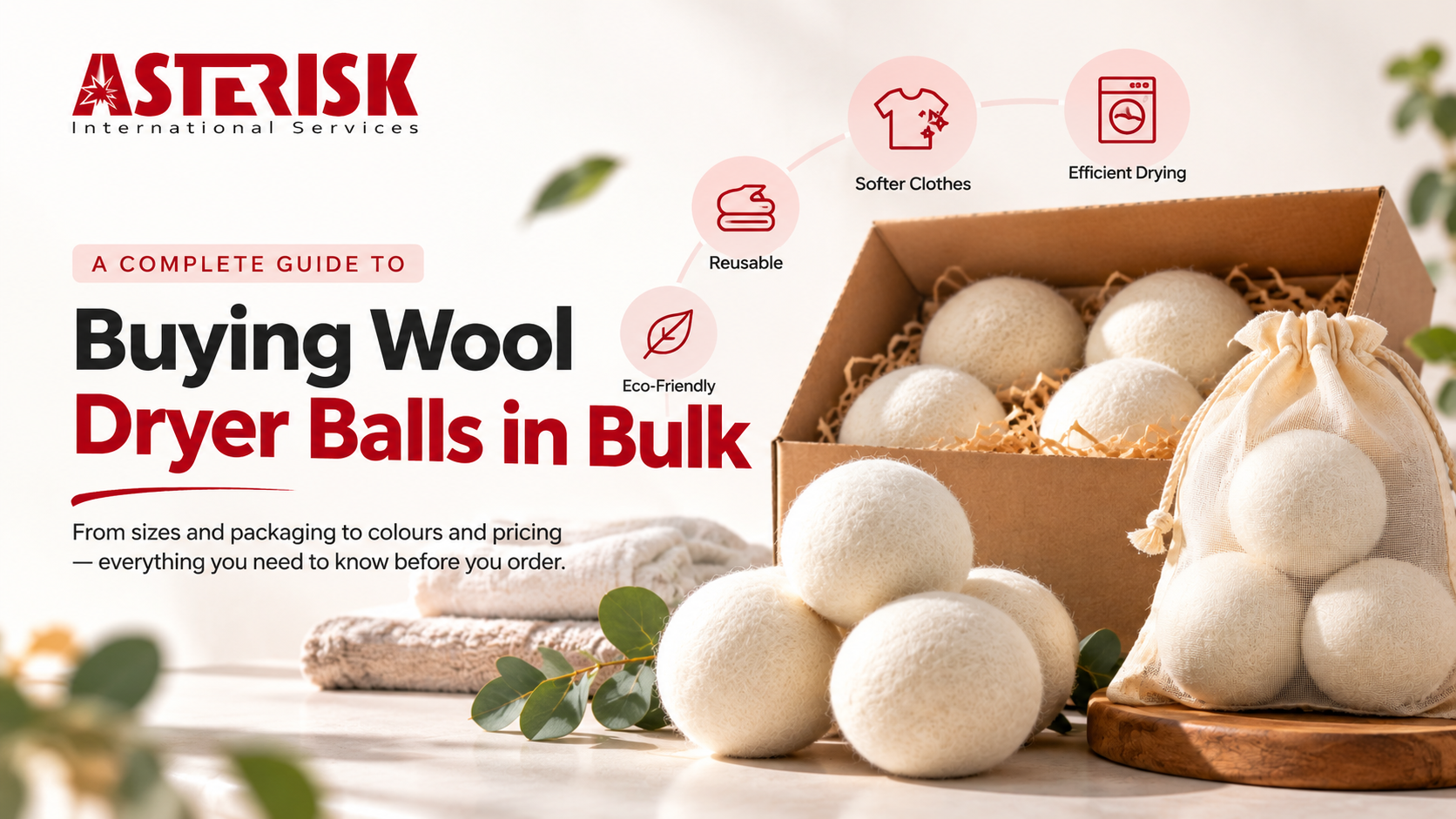
Buying wool dryer balls in bulk is a different decision from buying a retail 3-pack. You're not just picking a product you're choosing between unpackaged and packaged formats, deciding on size and set count, comparing colour options, and working out how price actually scales with volume. Get these decisions wrong and you end up with stock that doesn't match your shelf, your margin, or your customer's expectations. Here's what each choice actually means in practice.
Before getting into specs, it's worth being clear about who this product serves, since it shapes which format makes sense:
If you don't fit neatly into one of these, it's still worth identifying which one you're closest to it will tell a supplier what MOQ and packaging format to quote you first.
Unpackaged (loose) balls are sold by the hundred or thousand with no individual packaging just bulk cartons. This is the cheapest per-unit option because you're not paying for bags, boxes, or the labour to hand-pack sets. It makes sense if you're:
Packaged sets typically 3 or 6 balls in a drawstring bag or small box cost more per unit but arrive ready to sell. This is the standard format for retail shelf, online storefronts, and any buyer who doesn't want to handle a repacking step themselves.
There's rarely a middle ground worth pursuing: most buyers land on one of these two paths, either fully finished retail sets or fully loose balls they'll pack themselves. Decide which before you request a quote, because pricing, MOQ, and lead time all differ between the two and asking a supplier to quote both "just in case" usually slows the process down rather than speeding it up.
Wool dryer balls are most commonly sold around 2.75–3 inches (roughly 7 cm) in diameter about the size of a tennis ball.
Diameter alone is a weak indicator of quality, though. A ball can be felted loosely to reach a larger size while containing less actual wool and less density than a smaller, tightly felted one. Weight per ball is the more reliable signal it tells you how much wool went into the piece, not just how much air. If you're comparing two suppliers quoting similar prices, ask for the weight spec on both, not just the diameter.
Retail sets are almost always sold as 3 or 6 balls, since these match how most households use them per load (3 for a small load, up to 6 for a large one). Beyond the standard round ball, some brands offer novelty formats — sports-ball shapes, marbled or striped colour designs, seasonal shapes for gifting. These are a merchandising choice rather than a functional one: a themed ball dries laundry the same way a plain one does, but it can support a different price point or a gift-market angle.
Natural (undyed) balls come in the wool's own colour typically white, grey, or brown with no processing beyond felting. This is the lowest-risk option from a compliance standpoint, since there's no dye to test or disclose.
Dyed balls open up more retail merchandising options: colour-coded sets, seasonal colours, palettes matched to your packaging or brand. But dye adds a variable you need to manage. Ask any supplier directly whether their dyes are azo-free, and if colour consistency across a large order matters to your brand (it usually does, once customers start comparing sets online), request a pre-production sample in your exact chosen shade before committing to the full run. Dye lots can vary batch to batch even at the same factory, so a sample approved months ago isn't a guarantee for a new order.
Bulk pricing typically works in tiers — the price per unit drops as order quantity increases, and packaged sets always cost more per ball than loose ones, since you're paying for materials and labour on top of the wool itself. Expect a supplier to ask for your target quantity before quoting anything, because the per-unit price at 500 units and the per-unit price at 5,000 units genuinely aren't comparable, and a supplier quoting a single flat number regardless of volume is usually either padding the small-order price or lowballing you to win the deal before adjusting later. [CONFIRM: typical price breaks or quantity tiers Asterisk offers.]
It's worth asking for at least two or three quantity tiers in any quote request, even if you only plan to order one volume initially it gives you a sense of where the price curve flattens out, which is useful information for planning your next order.
A complete bulk quote should specify all of the following. If any of these is missing from a quote you receive, ask before ordering it's the single easiest way to avoid a shipment that doesn't match what you expected:
Loose and generically packaged balls work fine if you're bundling them into another product, or selling under a marketplace listing where your own branding isn't the main draw. But if you're building a retail or direct-to-consumer brand around this product, private label is generally where the actual margin sits. Common options include:
Private label usually raises the MOQ compared to plain packaging, since the supplier needs to justify a production run of your specific design. It's worth asking for a packaging proof a mockup or physical sample of the finished set approved before the full run starts, rather than after.
Even with a supplier you trust, it's worth running a small sample through a few basic checks before placing a full bulk order:
These checks take a day or two, but they catch problems while you're evaluating a handful of samples rather than after a 5,000-unit order has already landed at your warehouse.
Bulk orders are typically shipped by sea for larger volumes, where cost per unit matters more than speed, or by air for smaller or time-sensitive orders. From a manufacturer based in Nepal specifically, expect two separate timeframes: production lead time (how long it takes to make your order) and transit time (how long shipping takes once it leaves the factory). Ask for both separately some suppliers only quote one of the two, which can leave you with a very different total timeline than you expected.
For repeat orders using an existing design and colour, lead time is usually shorter than for a first order that involves new packaging, a new colour, or private-label artwork being produced for the first time.
Is loose (unpackaged) actually cheaper per unit?
Yes, generally. You're not paying for bags, boxes, or the labour involved in hand-packing individual sets, and minimum order quantities tend to be lower for loose product as well.
Do bigger balls dry laundry faster?
Size isn't the main factor density and wool content matter more than diameter. A large but loosely felted ball can actually underperform a smaller, denser one.
Can I mix sizes or colours within one bulk order?
Most suppliers can accommodate this, but it may affect both pricing and lead time compared to ordering a single uniform SKU. Raise this when you first request your quote, rather than after pricing has already been set.
What's a reasonable MOQ to expect?
It varies significantly by supplier and by packaging format. Loose balls typically carry lower minimums than private-label packaged sets, since packaging and branding require a dedicated production run.
How do I know if a supplier's wool claims are accurate?
Ask directly where the wool is sourced from and whether it's 100% wool or a blend, and request documentation if your market requires it. A supplier who answers vaguely on sourcing is often vague on other specs too.
We manufacture wool dryer balls in Nepal in both loose and packaged formats, with private label options available on request. Tell us your target quantity, size, colour, and packaging preference, and we'll quote accordingly. See our full wholesale wool dryer balls range or request a quote directly.
